

Writing an Effective Marketing Plan
amid the ‘New Normal’
Seven Things You Need to Know Before You Start
Writing an effective marketing plan is never achieved with guesswork or intuition, an effective marketing plan is based on facts: facts about your marketplace, your customers, and the general environment in which we all trade.
Despite the chaos and heartbreak that Covid-19 has caused, the chances are that you will need to reassess how to reach your preferred customers. Small business owners everywhere will need to review how marketing is done.
An Emphasis on Digital
People of every generation are moving online. Find out where they’re hanging out and what they’re using.
An Emphasis on Communication
Meaningful, person to person communication with your valued customers is more important than ever.
Although many rule-books have been somewhat ripped up of late, good practice in marketing planning hasnt changed.
In this article, we look at seven essential things that you need to know before you start work on your new plan.
1. Whats happening out there?
The world has been turned upsidedown and inside out by Coronavirus. Businesses have closed permanently, others have been forced to close indefinitely. Many however will be able to move their operations online and therefore it’s as important as ever to keep an eye on your trading environment. Technologies are being adopted at break-neck speed by both customers and suppliers and there’s every chance that these new ways of doing things will stick long after the Coronavirus has gone away.
Having an ear to the ground is vital. Not only from a technological perspective but also from a political, economic and social one. Whilst there will always be factors that are beyond your control, there will be others that, if you know about them, you could take advantage of, or devise a workaround for, and that will have a bearing on your marketing planning.
2. Your mission, vision & objectives
Mission and vision statements are culture-building tools and never more so than in the current climate. They help to inspire teams and other stakeholders. They provide focus, avoid distraction and get everyone on board and working towards the same goals. A defined mission and vision feed into an effective marketing plan and help to inform company objectives, making decision making clearer and therefore easier for all concerned.
In simple terms, a mission statement defines the current position. It describes the organisation, what it does, how it does it and who it does it for. Whereas a vision statement describes the future. It sets out what the business hopes to achieve and how they will do so. It helps everyone to focus on a common purpose and move together towards a collective goal.
3. Who are the competitors that matter?
All competitors matter. However, they come in different sizes and flavours! So-called close competitors have very similar products and target markets, and you may find yourself going head to head with them on a regular basis. Another type of competitor might offer alternative products that meet similar needs, or there may be less expensive products that have a similar level of functionality.
A thorough understanding of both customers and competitors will certainly provide some great insight when you’re writing a marketing plan, and will go a long way towards informing the direction to take. However, there are other factors to take into account too. For example, you could find that you have the edge over your main competitors because your business adopted online technologies sooner and is better at communicating with the market. Or you might have a faster delivery service or better after-sales support. Once again, you can use factors like these to your advantage and to steer your chosen marketing strategy.
4. Where your business fits in
Understanding the marketplace and knowing where your business fits, both from your own and your customer’s viewpoint is important. From your perspective, your business undoubtedly offers the best products at the best price. Your customers, on the other hand, may see things slightly differently and it’s useful to stand in your customer’s shoes before you stand in your own. That way you’ll get a true picture of how your enterprise stacks up against competitors. Customers tend to have their own take on what price versus value looks like, and this is often built around their wants and needs. Customers may well already have a favourite product, preferred brand or a long-standing supplier that they are loyal to. Knowing how your offering stacks up: whether you are a cost leader of differentiate in some other way will help you fine-tune your marketing messages for optimum effect.

5. Who your customer groups are
All customers are not created equal.
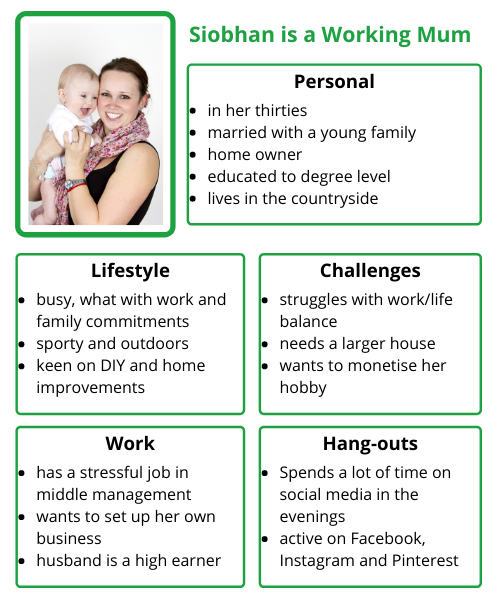
Every business will have customers that share certain characteristics. It’s helpful to group these customers together. That way, when you’re putting your marketing material together, you can do so in a way that will resonate with these groups, and then publish it in places where they hang-out. For the sake of simplicity, no more than 3 or 4 groups is about right. Any more and it becomes confusing with certain customers seeming to fit into several groups. Once you have formed your segments you can then give them personas.
A typical persona might look like this:
6. Where customers hang out
Personas provide some insight into where opportunities to do business with a particular customer segment might lie. Siobhan represents the affluent millennials with disposable income. this group strives for a good work-life balance and isn’t necessarily risk-averse. They can be engaged with strong imagery, messages about quality, and they can be found on social media during evening down-time.
If you know your market well, understand your competitors and have analysed your customer groups, you will be in a good position to start mapping marketing activity. It will be possible to plot out which channels to use and when to use them, and the language, tone of voice and images that will grab the attention of the people you want to connect with.
7. The extent of your resources
Part of writing a marketing plan includes ensuring that you have sufficient resources that you can allocate to delivering it.
It’s easy to underestimate how much time it takes to do well. You might need a mix of skills too: from copywriting to graphic design, social media know-how, digital and traditional marketing acumen, and a marketing person or team with a customer orientation.
Above all, it’s a really good idea to put some metrics in place and then decide which measures will feed into them. You could pop some key performance indicators into the mix too. As you do so, bear in mind that you can’t control what you don’t measure and if you know what works well, you’ll know to do more of it (and less of what doesn’t).
And finally..
In the normal world and if you’re a new business, it’s a good idea to write a plan that covers the forthcoming six months. Whereas more established businesses could write for a twelve-month period. However, given the current climate of uncertainty where things are changing daily, it’s probably a good idea to plan for no more than the next three to six months. However, bear in mind that methods that are being adopted now, if they work well, are likely to become the norm long after this current crisis is over.
We can help you with your audit, planning, and delivery. Contact us for more information. On the other hand, if you get on with it yourself, above all, good luck and have fun with it.

Written by Guest Blog
Related Articles
Top Tips For Getting Publicity
Top 10 Tips for Getting Publicity!Know and understand the publication that you want coverage in Write your news especially to their readership and style. You can always repurpose the story content with a different angle for a different publication.Build a...

Follow Us
Subscribe For Updates & Offers
Join our mailing list and be the first to read hot off the press articles