#63
In writing this 100 day blog it would be fair to say that some days are easier than others
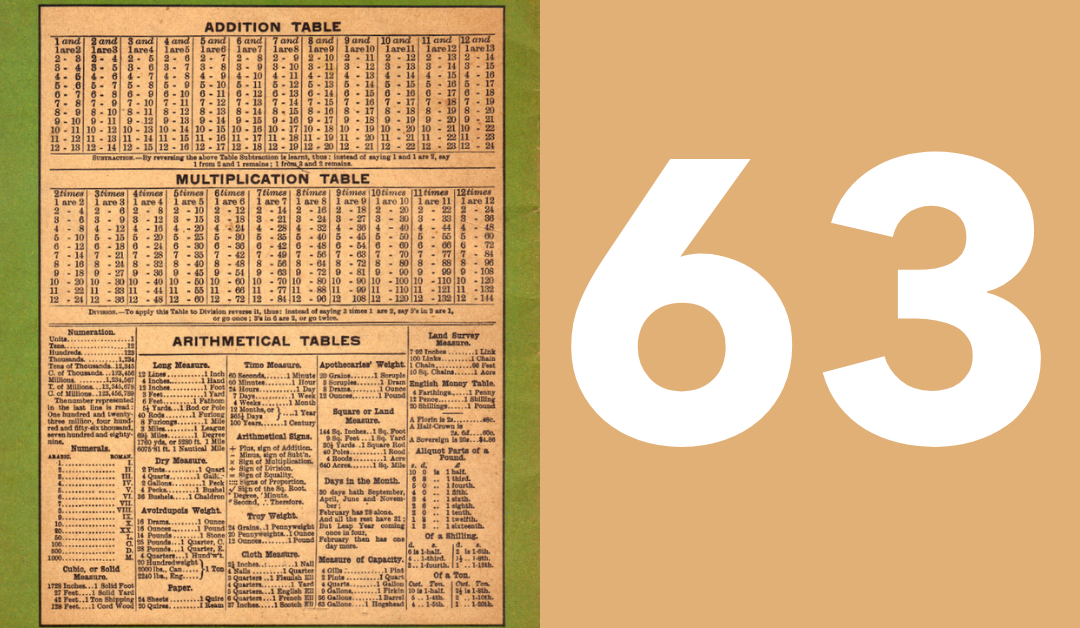
Which is how I knew that when I got to #63 it would be a straightforward case of sharing with you the kind of information every schoolboy (and girl) once took in their stride (with the help of an arithmetical table like the one in the photo)
Because 63 is of course…
The number of groats in a guinea!!!
Unless you’re in Scotland where they started off with 63 groats to the guinea then changed it to 31 ½ then 21
Of course
Easy huh..
And I bet most readers still don’t have a clue what a groat is (or a guinea for that matter)
Well FYI, a groat is a (now defunct) English and Irish silver coin worth four pence, and also a Scottish coin which was originally worth fourpence but then became eightpence and subsequently one shilling.
Oh and a guinea was 21 shillings or 1 pound (and a shilling)
A shilling you ask?
Well that was the equivalent of 12 pence (or 48 farthings)
Or 4 threepenny bits
Or 2 sixpences
Oh and they were sometimes called “tanners” (the sixpences) but don’t ask me why, it’s not as if I know everything
So groats, or fourpences as they were sometimes known (except in Scotland of course where presumably they were eightpences or maybe even twelvepences)
Groats were a silver coin first produced in the reign of King Edward 1 of England (1272 – 1307, which was quite a long reign for a monarch in those days)
Strictly speaking of course it should have contained four pennyweights (or 96 grains) of sterling silver (not pure silver you understand, oh no. You didn’t know there was a difference? Ok, we “might” come back to that later) but the first groats were actually only 89 grains and later ones became progressively lighter being reduced to 72 grains (three pennyweights) under Edward III 60 grains under Henry IV and 48 grains under Edward IV but only until 1559 when the weight was reduced to 32 grains, oh and it was no longer sterling silver but a cheaper version and then in 1561 they stopped making them
Which sounds nuts, they seem such a useful coin to have around
Which is why, I guess, they started again in 1786 (225 years later) and carried on making them for another 100 years
But by now they were only 27 grains and barely distinguishable size-wise from a silver threepenny piece (not to be confused with the aforementioned threepenny bit) although they were a little thicker apparently.
At times in the past they even had silver twopenny coins (tuppence) which were sometimes referred to as half groats
And don’t just dismiss all of this as “old money”
Groats remained in general circulation in British Guiana right up until 1955 when they adopted the decimal system
18 years before we did in the UK!!
Just to add to the confusion the aforementioned sterling silver “grains”, that made up the pennyweights, that made up the groats were the equivalent weight in silver of a grain of wheat
And they were also called groats!
Making one “groat” the equivalent of 89, 72, 60, 48, 32 or 27 “groats”
Confused?
Me too
And that’s before we even get started on how many shillings in a florin, florins in a crown, crowns in a pound and so on and so on, not to mention that pounds are also a symbol of weight and come in 16 ounces made up of 16 drams unless (of course) you’re an apothecary in which case your pound has only 12 ounces made up of 8 drams each the result of 3 scruples of 20 grains (or half a groat) each
There they are again
Oh and by the way a dram is also a unit of liquid measurement the equivalent of a teaspoonful which is 60 minims but when teaspoons got bigger became 80-85 minims unless you’re Scottish in which case a dram refers to an unspecified amount of whisky poured into a glass and…
STOP THE WORLD!!!!
My head’s spinning
And I guess yours is too
The whole thing is just so confusing
But this is what we’ve lived with all over the world for the past 1000 years (and in many cases continue to do so) and we take this same confusion with us everywhere else too.
Let me ask you a simple question.
What does your business do?
Can you answer that in words that a five year old would understand?
Or a ten year old?
Fifteen year old?
Anyone in fact that isn’t you?
If your answer isn’t crystal clear to the point that your ideal client immediately feels compelled to give you money then you need to address the situation
Sharpish
Because you’re otherwise losing money that should be rightfully yours
Throughout this 100 day blog series I’m attempting to not only discipline myself into writing on a daily basis with all the benefits that brings me and my business
More importantly I’m attempting to share some of the wisdom I’ve acquired in 40 years of business, 30 of which have involved running my own small businesses.
So that you don’t have to make the same mistakes I’ve made
And one of the biggest mistakes I’ve made and keep seeing repeated time and time again is…
Overcomplicating the offer
Failing to keep it simple
So today’s lesson (and challenge) is this
Set aside some time to have a proper think about your business and the way you communicate it to others
What is your product or service?
Who is your ideal client?
Is your product or service easily accessible (and purchasable) to your ideal client?
And if the answer to the last question is no give me a call
I help small business owners just like you better communicate their offer to their ideal client saving them time and stress and making them money, money, money!
It really is that simple
#100daychallenge #100days2success #sixoclockclub100