#56
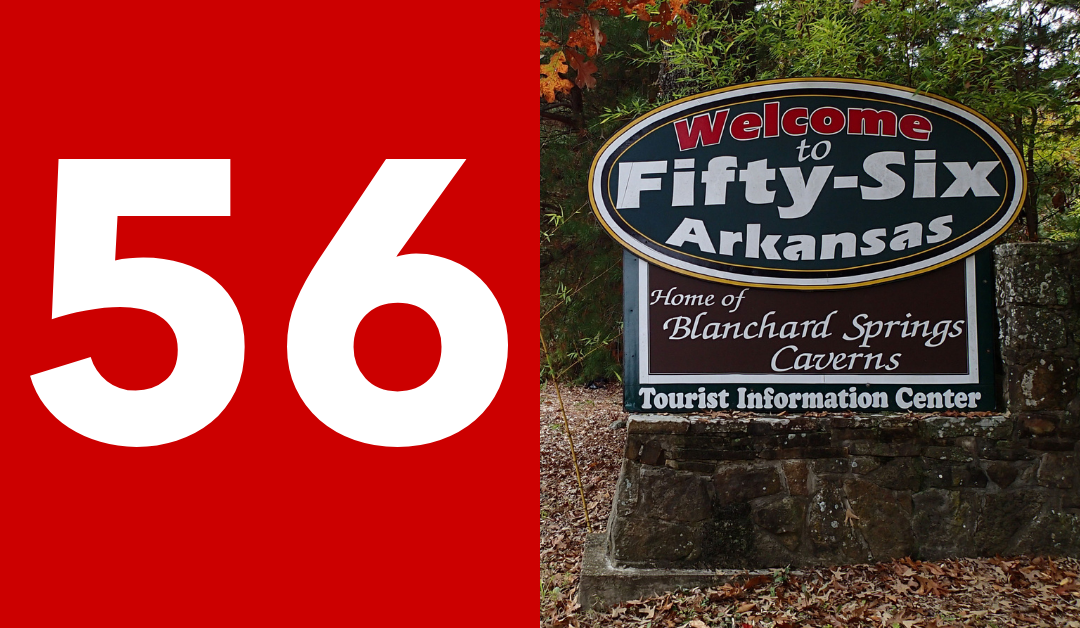
In Arkansas, USA there are two places called “56”
Or rather, according to Wikipedia, there’s “Fifty-Six, Arkansas” (Not to be confused with Fiftysix, Arkansas) and there’s “Fiftysix, Arkansas” which is “obviously” (Not to be confused with Fifty-Six, Arkansas)
Unfortunately, Wikipedia doesn’t tell us how two places with such unusual, near identical names came to be, just 108 miles apart, when there’s (seemingly) no other place in the world with this name but it’s by no means unique.
There are two places called “Seventy Six” for example, Seventy-Six, Missouri and Seventy Six, Kentucky, the latter of which no longer has a Post Office, apparently.
“Hundred” in West Virginia was named after the fact that one of the first inhabitants lived to the ripe old age of 109. “Ninety Six” in South Carolina after the surveyor’s estimate that the town was 96 miles from Keowee, an important Cherokee community.
Many of these towns appear to have been named by the postmaster or postmistress at the time. The story behind “Twentysix” in Kentucky is that the community’s first postmaster, Martha Rowland, submitted 25 possible community names, and then jotted down “26,” which was the year she submitted the list.
The town of Eighty-Eight, Kentucky was named by postmaster Dabnie Nunnally, who figured that “88” would be readable even in his own bad handwriting. The number apparently came from the amount of change in his pocket.
Others are more ambiguous citing stories as wild as the number of settlers who survived a bad winter to the year or even the number of Native Americans killed in a battle.
Either way the one thing they all have in common is precedent
Someone made the random decision, and everyone followed suit
In business this is often known as “first mover advantage”
The person who decides the way things are done or who does it first.
But be warned, it’s not always the case. Just because you have a great idea doesn’t mean you’ll make a great success off the back of it.
It’s all about the execution
In July 1981, just 39 years ago, Bill Gates did exactly that faced with an opportunity to supply IBM with an operating system to run their new personal computers.
Rather than start from scratch and build their own, Gates thought it wiser to buy an existing solution called 86-DOS, or QDOS (quick and dirty operating system) from a company called Seattle Computer Systems which he subsequently renamed MS-DOS.
He paid them a total of $55,000 for exclusive rights to the system they’d invented.
Everyone knows what happened next, Microsoft went on to become one of the largest companies in the world and Bill Gates one of the riches. Few people even know who the owner of Seattle Computer Systems was let alone what happened to the company.